< Perspectives
Drainage catheter anatomy – How different features impact you and your patients

Drainage catheters are used across a broad spectrum of clinical cases from nephrostomy to ascitic drainage to biliary care. With a huge range of catheters to choose from, how do you determine which features will actually benefit your team and your patients? Catheters are not one-size-fits-all, and not all catheters will offer the same levels of comfort, drainage efficiency or ease of use.
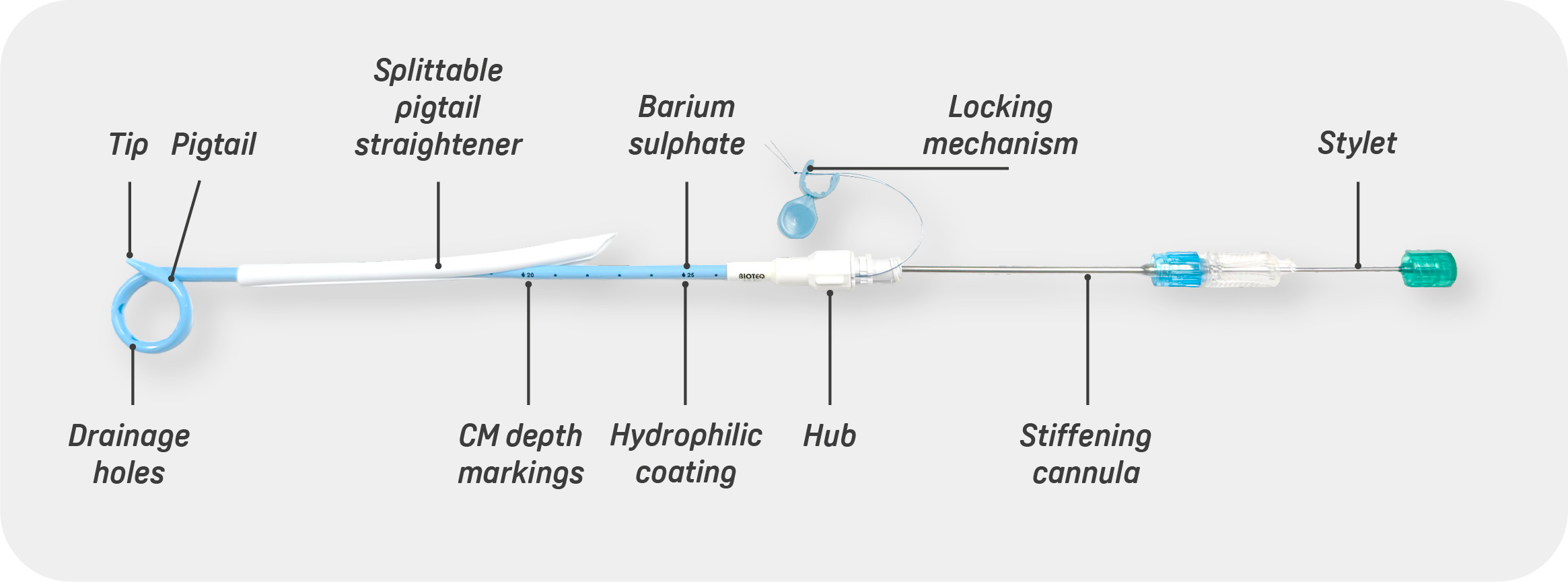
Let’s break down the anatomy of a catheter and how each feature affects clinical practice…

Tip
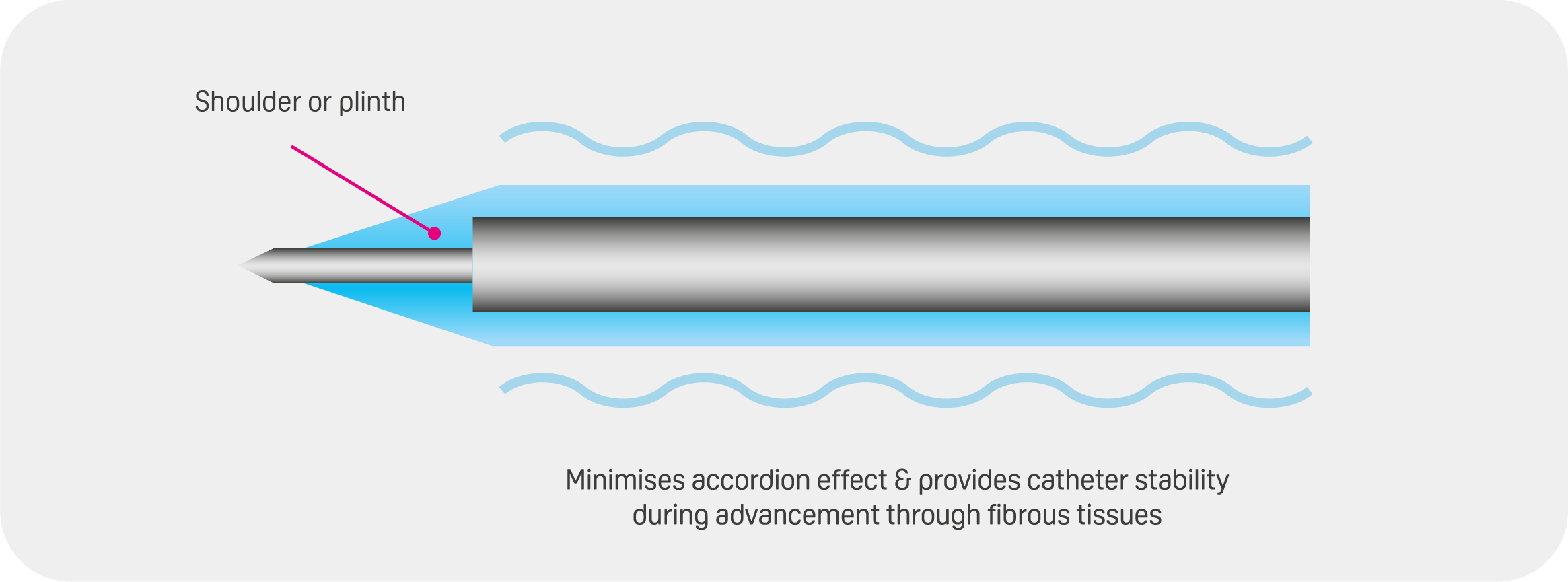
For ease of insertion, opt for a catheter with a plinth tip.
The tip usually houses the sharp stylet for advancing the catheter into place. On the Neo-Hydro, the tip contains a plinth-shoulder design to reduce the accordion effect during insertion. The accordion effect is when the stylet advances into the tissue but the catheter itself does not, bunching at the skin surface. This is what the plinth tip of a Neo-Hydro looks like:
Drainage holes
For higher flow rates, look for large, elliptical drainage holes. To make catheter exchange a breeze, look for skived drainage holes
Within the pigtail (or J on a J-shape catheter) you’ll find the drainage holes. This is one of the design elements that can really affect function, especially for ascitic drainage. In catheters where circular holes have been cut into the catheter while it was straight, the holes will actually become a lot smaller once the pigtail curls. The size of the drainage holes has a direct impact on flow rates – so if being able to drain quickly is a priority for you, look for a device with large, elliptical holes.
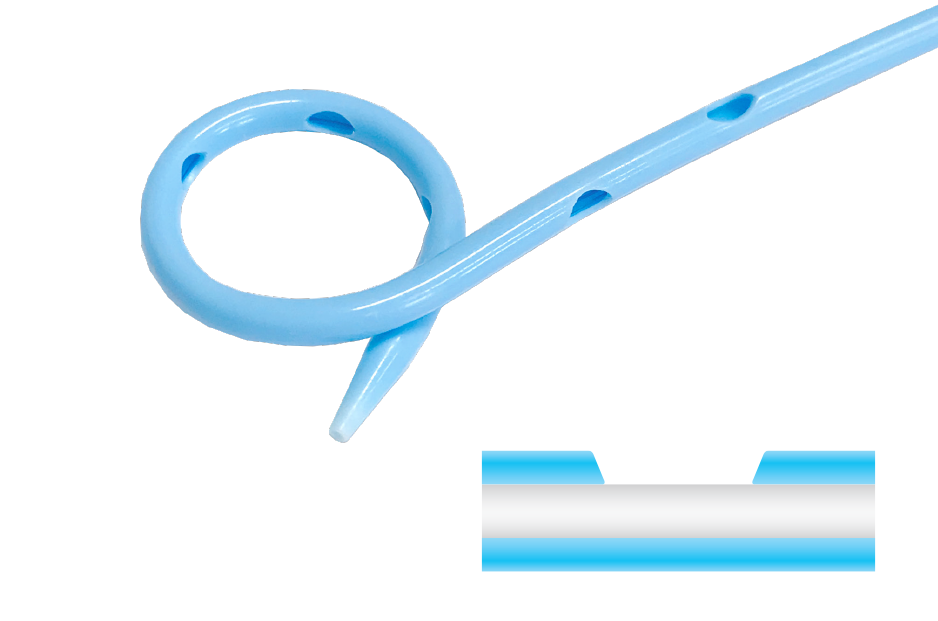
For nephrostomy, encrustation can be a big issue, and sometimes the catheter can make it worse. Look for a device with skived drainage holes if encrustation is a concern for you; the skiving process reduces porosity in the hole surface profile, meaning the calcium oxalates responsible for encrustation can’t adhere to the catheter as easily. A catheter that’s less prone to encrustation means catheter exchange is easier for you and more tolerable for the patient.
Splittable pigtail straightener
A handy accessory for straightening the catheter without touching it.
Some catheters come with a detachable pigtail splitter – a handy accessory which allows you to straighten the pigtail and guide the catheter without having to touch the catheter itself.

CM depth markings
A visual aid for implantation and catheter surveillance.
Most catheters nowadays will have centimetre depth markings running down the length of the catheter – this is useful both for during insertion and monitoring the catheter, so you know how much of it has been advanced into place. Does what it says on the tin, really!

Hydrophilic coating
Makes the insertion process smoother (literally)
Many catheters have a hydrophilic coating which means less resistance during implantation. Hydrophilic = water loving, and obviously, the catheter is going into a fluid-filled space. Hydrophilic coatings mean less force to penetrate, and better comfort for your patient.
Barium sulphate content
It’s a delicate balance between stiffness and visibility…
Too little barium sulphate and you won’t get the visibility you need for confident placement under ultrasound – this means higher procedural risk and longer procedure times. On the flipside, too much and your catheter will be stiff and inflexible – higher trauma risk and a more brittle device that could be more prone to failure. The sweet spot is somewhere between 10-20% to maintain radiopacity without compromising the integrity of the catheter.
Locking mechanism
Scissors shouldn’t be necessary for catheter exchange
One of the most variable features of drainage catheters is probably in the locking mechanism. There are lock-and-key types, clips, flanges, levers… the list goes on. Ultimately, there isn’t a right or wrong type and it’s all down to what works best for your team, although scissors shouldn’t really be necessary for catheter exchange. If your catheter requires you to cut it to unlock the pigtail, there’s an increased risk of leaving a foreign body behind. Your catheter should be easy to remove without the additional risks that come with having to cut it.

Hub
An important consideration for patient comfort and wellbeing
The hub is the point of the catheter that attaches to a drainage bag and is another design feature that can vary a lot. While many say they are leak-proof, fluid manages to wick its way down the threads and escape the catheter. Look for designs that are both leak-proof and anti-wicking to give your patients that extra layer of security. Additionally, the profile of the hub can impact patient comfort – if the hub is particularly bulky, there’s a good chance it’s going to be uncomfortable for your patient.
Stiffening cannula
Procedural flexibility and reliable rigidity
Stiffening cannulas serve to maintain rigidity during the insertion process while advancing the catheter into place. For nephrostomy, this gives you procedural flexibility – it will fit over a guide wire and be stiff enough to advance into the kidney. For biliary drainage, many catheters have a flexible, atraumatic stiffening cannula option – like the Neo-Sof. We have catheters specifically designed for nephrostomy which you can find here.
Stylet
Most important for direct puncture procedures
The stylet is the innermost component that comes in your catheter kit – the needle. Sharpness is important for both patient tolerance and ease of use for you. While guide wires tend to be used instead of the stylet for nephrostomy, ascitic drainage tends to be direct puncture, so that’s probably where the stylet plays the most important role. It’s important to consider the amount of ‘dead space’ at the tip of the stylet – a larger dead space means higher risk of perforation once you’re in the cavity.
Drainage catheter range
Our range of drainage catheters, bags and fixation devices were developed to bring meaningful value to both you, the user, and your patients. Take a look at our range here.
< Perspectives


