Women diagnosed with early, localised breast cancer have a five-year survival rate of over 99%.1
This is exactly why the breast screening programme exists – to detect breast cancer before symptoms appear, making treatment more effective.
Between 2024-2025, 19,291 breast cancers were detected through screening.2

How many people don't attend?
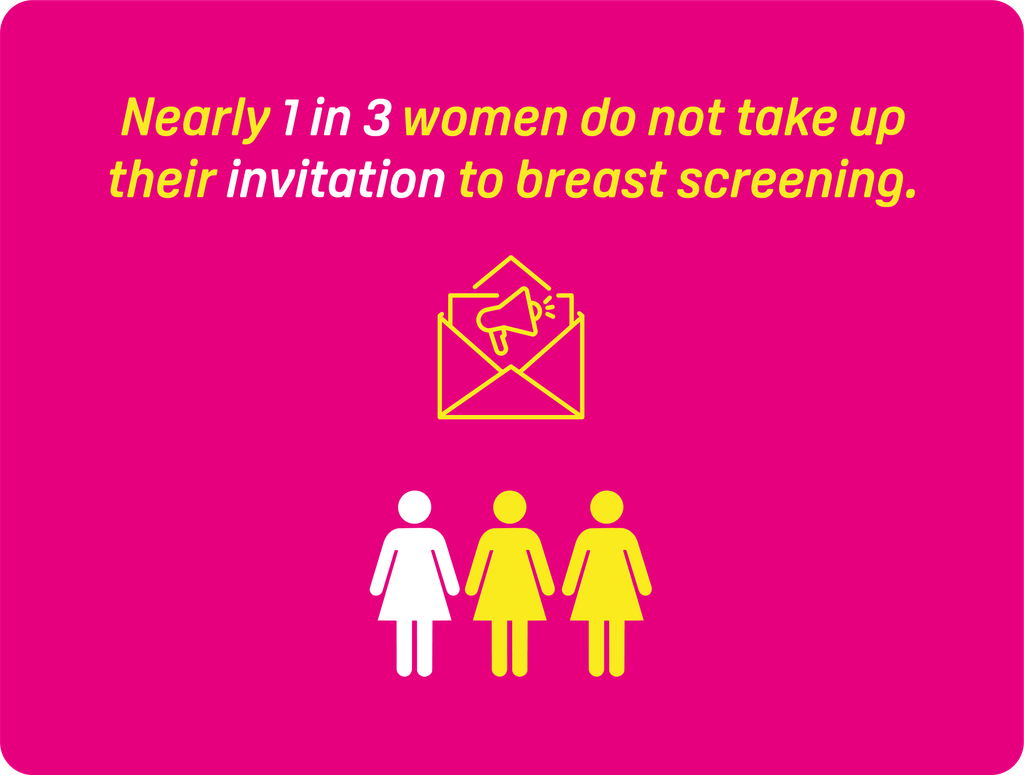
Nearly 1 in 3 women do not take up their invitation to breast screening.2
Just 1 in 5 women who had previously missed an invitation attended their next one.3
Women living in more deprived areas are less likely to attend breast screening and have worse breast cancer outcomes, including higher mortality.4
A snapshot across England
Screening uptake rates across England:

Ethnicity & breast screening uptake
Some studies have found screening uptake rates vary significantly by ethnicity – but NHS England have acknowledged there isn’t sufficiently detailed data yet.7
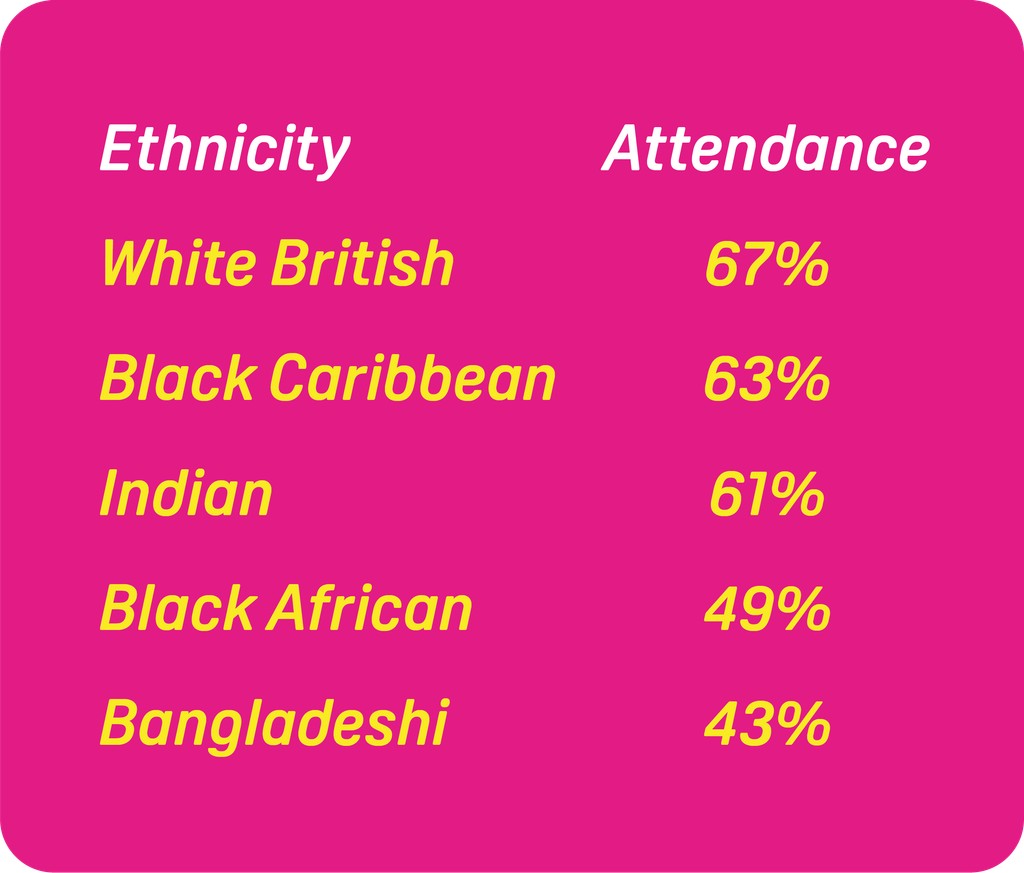
One large London based study of 475,478 women evaluated attendance rates after the first screening invitation between 2006 and 2009: 7
UK studies have found lower breast screening uptake among Muslim women compared with some other groups. The reasons are complex, including barriers relating to language, misconceptions, modesty, privacy, access and trust.8
In one study, British-Pakistani women have reported concerns about modesty and exposure as a barrier to screening; particularly uncertainty about whether the mammographer will be a woman.9

Other key themes identified in conversations with the women in the study were:
- The absence of autonomy in screening and healthcare access, often due to limited literacy in English – meaning invitation via letter can be problematic.
- Ineffective screening materials – only 2 women out of those who said they had attended screening recalled being able to access information about the breast screening programme and understand what would happen at their appointment.
- Incomprehensible terminology - in the common languages spoken by the British-Pakistani community (i.e. Urdu), clear and direct translations of screening terminology is lacking. The uncertainty over what these terms denote caused some women to speculate about what would happen during their appointments, often resulting in inaccurate suppositions.
- Screening presents challenges to cultural beliefs – the necessity to reveal breasts to a stranger is a major deterrent to attending breast screening for British-Pakistani women. It was apparent that if women knew that a female radiographer would be performing the mammogram, they would be more inclined to attend.

Learning disabilities & autism
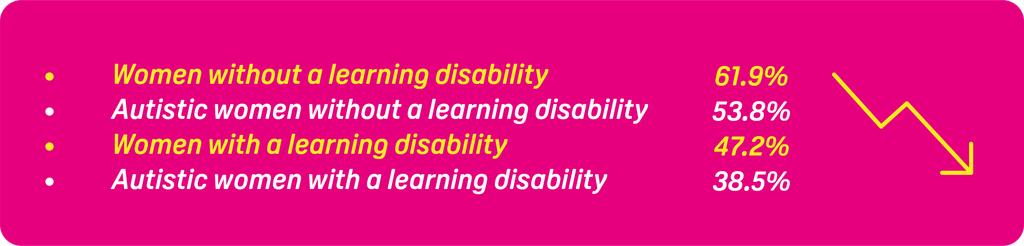
Screening uptake rates in women with learning disabilities & autism:10
Physical disabilities
A 2026 NHS England review acknowledged that current mammography equipment and protocols mean screening is not possible for some women with a physical disability, however there is no comprehensive data on this.11
Services are expected to make reasonable adjustments, but current equipment can still create barriers for some women with physical disabilities.
Mammography requires a degree of upper body strength and control for the patient to be able to maintain their position during imaging. Some disabled women cannot access screening for this reason.
The NHS is now actively engaging mammography manufacturers about equipment accessibility. There is also ongoing research conducted by the University of York and York Hospital’s breast imaging team to create a robotic arm to assist with patient positioning in disabled women.12
Gender
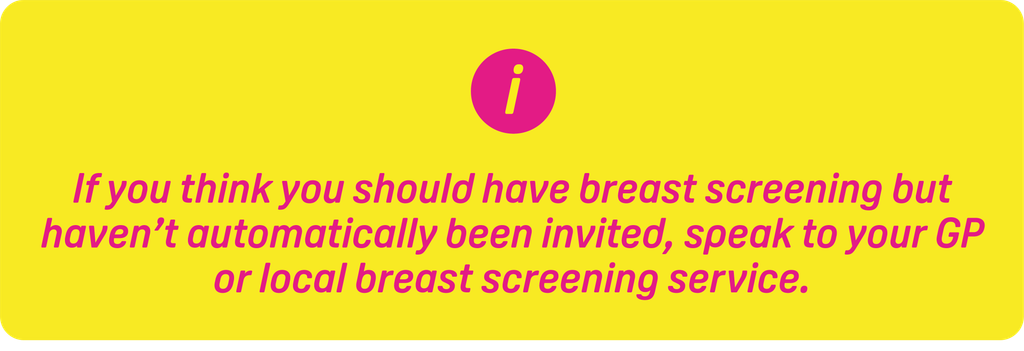
Not everyone at risk of breast cancer receives an automatic invitation to attend breast screening. For trans and non-binary people, whether an automatic invitation is generated depends on the sex recorded in their GP record.13
- Trans women registered as male with their GP are not automatically invited, even if they have developed breast tissue through hormone therapy.
- Trans men registered as male with their GP are not automatically invited, even if they still have breast tissue.
Breast cancer can affect men too – but they are not routinely invited to breast screening.
- The lifetime risk for breast cancer in men is less than 1 in 100.
- Around 400 men are diagnosed with breast cancer in the UK each year.
- Breast cancer in men accounts for less than 1% of all breast cancers.14
The picture is improving… but there is still work to be done.
Continued progress requires recognising that people experience different barriers to accessing and attending screening and working together to remove them.
Wherever someone lives, whatever their background, disability, gender or circumstances, everyone should have a fair opportunity to access breast screening.
Because everyone deserves the opportunity to find breast cancer early.
Because finding breast cancer early can save lives.
Click here to find out more about what to expect when you attend breast screening for the first time.

References
- National Cancer Institute (n.d.) Breast cancer survival rates. Available at: https://www.cancer.gov/types/breast/survival (Accessed: 8 September 2026).
- NHS England (2025) Breast screening programme, England – 2024-25. Available at: https://digital.nhs.uk/data-and-information/publications/statistical/breast-screening-programme/england-2024-2025 (Accessed: 8 September 2026).
- NHS England (2024) Breast screening programme, England – 2023-24: Main report. Available at: https://digital.nhs.uk/data-and-information/publications/statistical/breast-screening-programme/england---2023-24/mainreport2324 (Accessed: 8 September 2026).
- Department of Health and Social Care (2025) Health trends and variation in England 2025: A Chief Medical Officer report. Available at: https://www.gov.uk/government/publications/health-trends-and-variation-in-england-2025-a-chief-medical-officer-report/health-trends-and-variation-in-england-2025-accessible-version (Accessed: 8 September 2026).
- UK Health Security Agency (n.d.) Ethnicity, deprivation and screening survival from breast cancer: a population-based study. Available at: https://researchportal.ukhsa.gov.uk/en/publications/ethnicity-deprivation-and-screening-survival-from-breast-cancer-a/ (Accessed: 8 September 2026).
- NHS England (2025) Breast screening programme, England – 2024-25: Main report. Available at: https://digital.nhs.uk/data-and-information/publications/statistical/breast-screening-programme/england-2024-2025/mainreport2425 (Accessed: 8 September 2026).
- Jack, R.H., Møller, H., Robson, T. and Davies, E.A. (2014) ‘Breast cancer screening uptake among women from different ethnic groups in London: a population-based cohort study’, BMJ Open, 4(10), e005586. Available at: https://pmc.ncbi.nlm.nih.gov/articles/PMC4202018/pdf/bmjopen-2014-005586.pdf (Accessed: 8 September 2026).
- Szczepura, A., Price, C. and Gumber, A. (2008) ‘Breast and bowel cancer screening uptake patterns over 15 years for UK South Asian ethnic minority populations, corrected for differences in socio-demographic characteristics’, BMC Public Health, 8, 346. Available at: https://pmc.ncbi.nlm.nih.gov/articles/PMC2575216/ (Accessed: 8 September 2026).
- Woof, V.G., Ruane, H., Ulph, F., French, D.P., Qureshi, N., Khan, N., Evans, D.G. and Donnelly, L.S. (2020) ‘Engagement barriers and service inequities in the NHS Breast Screening Programme: views from British-Pakistani women’, Journal of Medical Screening, 27(3), pp. 130–137. Available at: https://pmc.ncbi.nlm.nih.gov/articles/PMC7645618/ (Accessed: 8 September 2026).
- NHS Digital (2023) Health and care of people with learning disabilities: Experimental statistics 2021 to 2022 – Cancer screening. Available at: https://digital.nhs.uk/data-and-information/publications/statistical/health-and-care-of-people-with-learning-disabilities/experimental-statistics-2021-to-2022/cancer-screening (Accessed: 8 September 2026).
- NHS England (n.d.) Breast screening: reducing inequalities. Available at: https://www.gov.uk/government/publications/breast-screening-identifying-and-reducing-inequalities/breast-screening-reducing-inequalities (Accessed: 8 September 2026).
- ITS Interventional (n.d.) How robots could be used to improve access to breast screening. Available at: https://itsinterventional.com/perspective/how-robots-could-be-used-to-improve-access-to-breast-screening/ (Accessed: 8 September 2026).
- NHS England (n.d.) NHS population screening: information for trans people. Available at: https://www.gov.uk/government/publications/nhs-population-screening-information-for-transgender-people/nhs-population-screening-information-for-trans-people (Accessed: 8 September 2026).
- Cancer Research UK (n.d.) Male breast cancer. Available at: https://www.cancerresearchuk.org/about-cancer/breast-cancer/types/male-breast-cancer (Accessed: 8 September 2026).